
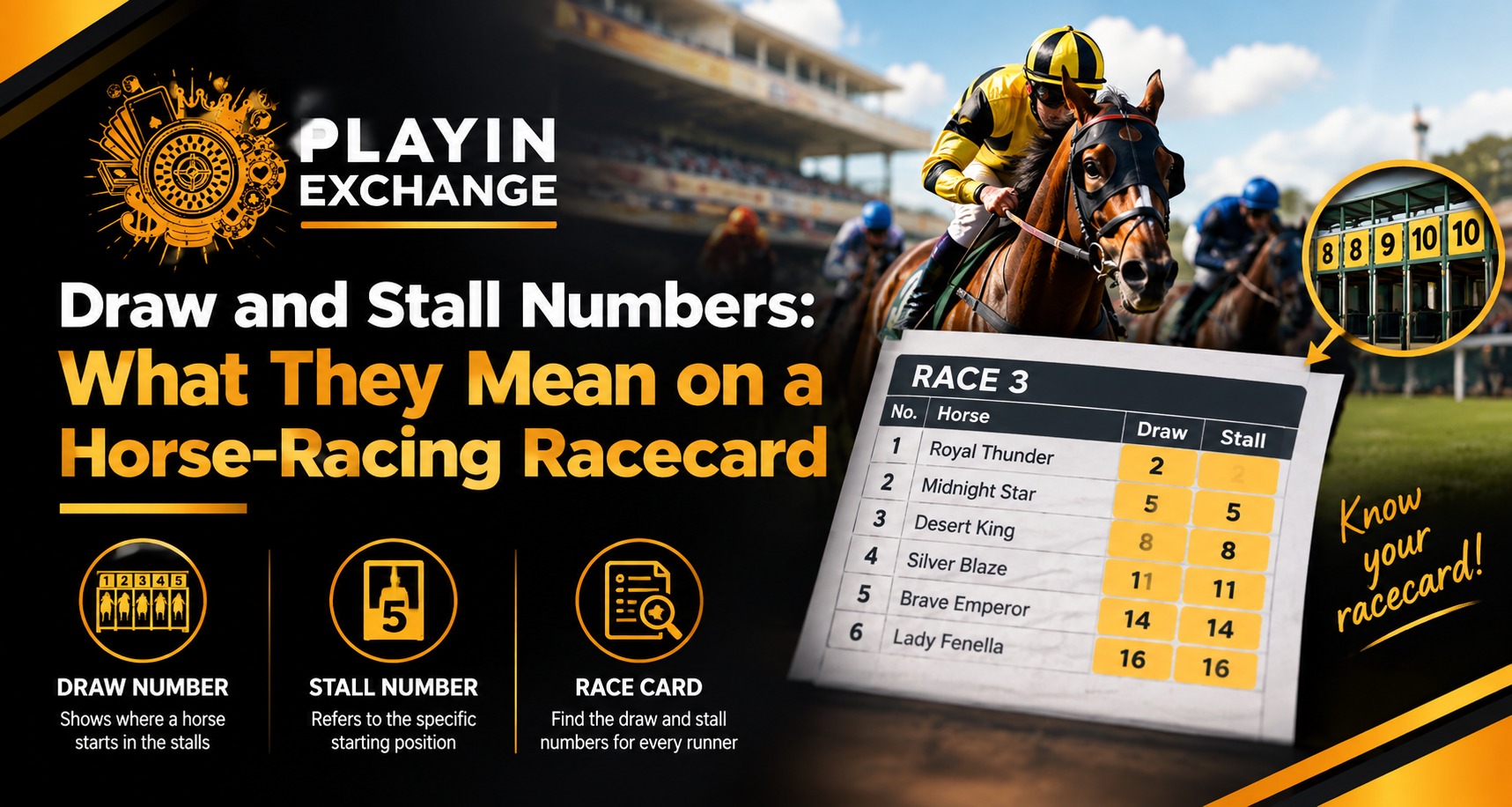
Horse-racing racecards contain several numbers that can look confusing when you are just getting familiar with the sport. One of the most important is the draw, which tells you where a horse will start in races that use starting stalls.
For Playinexch users reading horse-racing information, understanding draw and stall numbers can make a racecard much easier to follow. The draw is especially relevant in flat racing, where horses begin from numbered starting stalls. Racing Post’s racecard glossary defines the draw as the horse’s stall position in flat racing.
What Does “Draw” Mean in Horse Racing?
The draw is the starting stall allocated to a horse before a flat race. Each runner receives a number corresponding to its position in the starting stalls.
For example, imagine a race with eight runners:
- Horse A — Stall 1
- Horse B — Stall 2
- Horse C — Stall 3
- Horse D — Stall 4
- Horse E — Stall 5
- Horse F — Stall 6
- Horse G — Stall 7
- Horse H — Stall 8
The number does not indicate the horse’s finishing position or its ability. It simply identifies its allocated starting position.
The British Horseracing Authority includes draw information among the details published on racecards for flat races.
What Is a Stall Number?
A stall is one of the individual compartments in the starting gate. Horses are loaded into these stalls before the race begins, and the gates open simultaneously to provide a fair start.
The stall number identifies the horse’s position within the starting gate. The arrangement can matter because the physical layout of the course may influence how quickly a runner can reach a preferred racing position.
The BHA explains that starting stalls are used in flat racing because shorter races require participants to begin in as straight a line as possible.
Is a Low Draw Always Better?
No. There is no universal rule that says a low draw is automatically better than a high draw.
The potential value of a stall depends on several factors, including:
- Course layout
- Race distance
- Position of the first bend
- Width of the track
- Number of runners
- Going and weather conditions
- Running style of the horse
- Historical course trends
A low-numbered stall may be useful at one track and less helpful at another. Similarly, a high draw can sometimes offer an advantage depending on the configuration and conditions.
This is why draw statistics should be viewed in context rather than treated as a simple “low is good, high is bad” rule.
Why Does Track Layout Matter?
Imagine a short race where the first bend comes soon after the starting stalls. A horse starting close to the inside may have a shorter route into the bend, while a runner starting wider could potentially need to cover more ground to obtain a similar position.
The opposite can happen when the course layout or prevailing conditions favour runners positioned toward another part of the track.
Historical evidence demonstrates that draw effects can vary significantly between courses and distances. Racing Post’s analysis of the Derby, for example, found different historical winning rates across stall groups rather than one simple advantage applying to every position.
Draw and the Number of Runners
The number of runners is another important consideration.
A stall number by itself tells you relatively little without knowing the size of the field. Being drawn 8th in an eight-runner race is very different from being drawn 8th in a 16-runner race.
For this reason, some race analysts consider a horse’s draw relative to the total number of runners rather than looking only at the absolute stall number.
For example:
- 2nd of 8 = relatively low draw
- 8th of 16 = around the middle
- 14th of 16 = relatively high draw
This relative position can provide more useful context when comparing races.
Draw Bias: What Does It Mean?
You may come across the term “draw bias” when reading racing analysis. A draw bias refers to a historical tendency for horses starting from certain parts of the stalls to perform better or worse under particular conditions.
However, a historical bias is not a guarantee.
Weather, going, field size, pace and changes to the track can all influence how a race develops. Racing Post’s racecard glossary also includes draw bias and impact-value statistics when assessing historical stall performance.
Therefore, draw data should be considered alongside other race information.
How Running Style Can Interact With the Draw
A horse’s preferred running style can influence how useful its starting position might be.
A front-runner may want to establish a prominent position quickly. A horse that normally races toward the back may be less concerned about immediately securing an inside position.
This creates an important distinction: the same stall can have different practical implications for different horses.
When studying a racecard, consider the draw together with:
- The horse’s normal running style
- The distance of the race
- The location of the first major turn
- The expected pace
- Historical results at the course
Draw Number vs Racecard Number
New readers sometimes confuse a draw number with a horse’s racecard or saddlecloth number.
They are not necessarily the same thing.
The racecard number identifies the runner for the race and is commonly displayed on the horse’s saddlecloth. The draw identifies its starting stall in flat racing. Racing Post distinguishes the racecard number from the draw in its racecard information.
A horse could therefore have one number on the racecard and start from a different stall.
What About Jump Racing?
Draw numbers are primarily associated with flat racing because flat races commonly use starting stalls.
Jump races generally use a different starting procedure, with horses beginning from a standing start or tape rather than the same starting-stall arrangement used for flat racing. The BHA notes that longer races, including jump races, allow riders more opportunity to choose tactical positions from the start.
As a result, readers should not assume that draw information applies identically across every type of horse race.
How to Read Draw Information More Effectively
When using the Playinexch Login Apk or reviewing a racecard online, avoid looking at the draw in isolation.
A practical approach is:
- Identify the total number of runners.
- Note each horse’s stall.
- Check the race distance.
- Look at the course configuration.
- Consider the horse’s running style.
- Review relevant historical draw statistics.
- Consider current track and weather conditions.
- Compare the draw with the horse’s recent form.
This provides a more balanced picture than focusing on one number.
Final Thoughts
Draw and stall numbers are useful parts of a horse-racing racecard, but they need context. A low or high draw does not automatically make a horse more likely to perform well. The importance of the position depends on the course layout, distance, field size, running style and prevailing conditions.
Whether you are accessing Play Exchange information or simply learning how to read a racecard, understanding the difference between racecard numbers and draw numbers is a useful starting point. Treat the draw as one piece of information within the wider race picture rather than as a standalone prediction.
Frequently Asked Questions
What does the draw mean on a horse-racing racecard?
The draw indicates the starting stall allocated to a horse in a flat race.
Is stall 1 always the best position?
No. The value of a stall depends on the course, distance, field size, conditions and other factors.
What is a draw bias?
A draw bias is a historical tendency for horses starting from certain stall positions or areas of the track to perform differently under particular conditions.
Is the draw the same as the horse’s racecard number?
No. The racecard number identifies the runner, while the draw identifies its starting stall.
Does the number of runners affect the importance of the draw?
Yes. A stall position should be considered relative to the size of the field and the layout of the racecourse.
Can a high draw be advantageous?
Yes. Depending on the course, distance, conditions and track position, higher-numbered stalls can sometimes be favourable. Historical draw advantages can vary considerably between races and courses.
Does draw matter in every horse race?
No. Draw information is primarily relevant to flat races using starting stalls. Jump races use different starting procedures.
Should draw be the main factor when assessing a race?
No. Draw is one factor among many. Form, fitness, distance, going, running style, trainer and jockey records, and race conditions can all be relevant.
What should beginners remember about stall numbers?
The simplest rule is that a stall number tells you where the horse starts, not how good the horse is. Its importance depends on the specific race and course.