
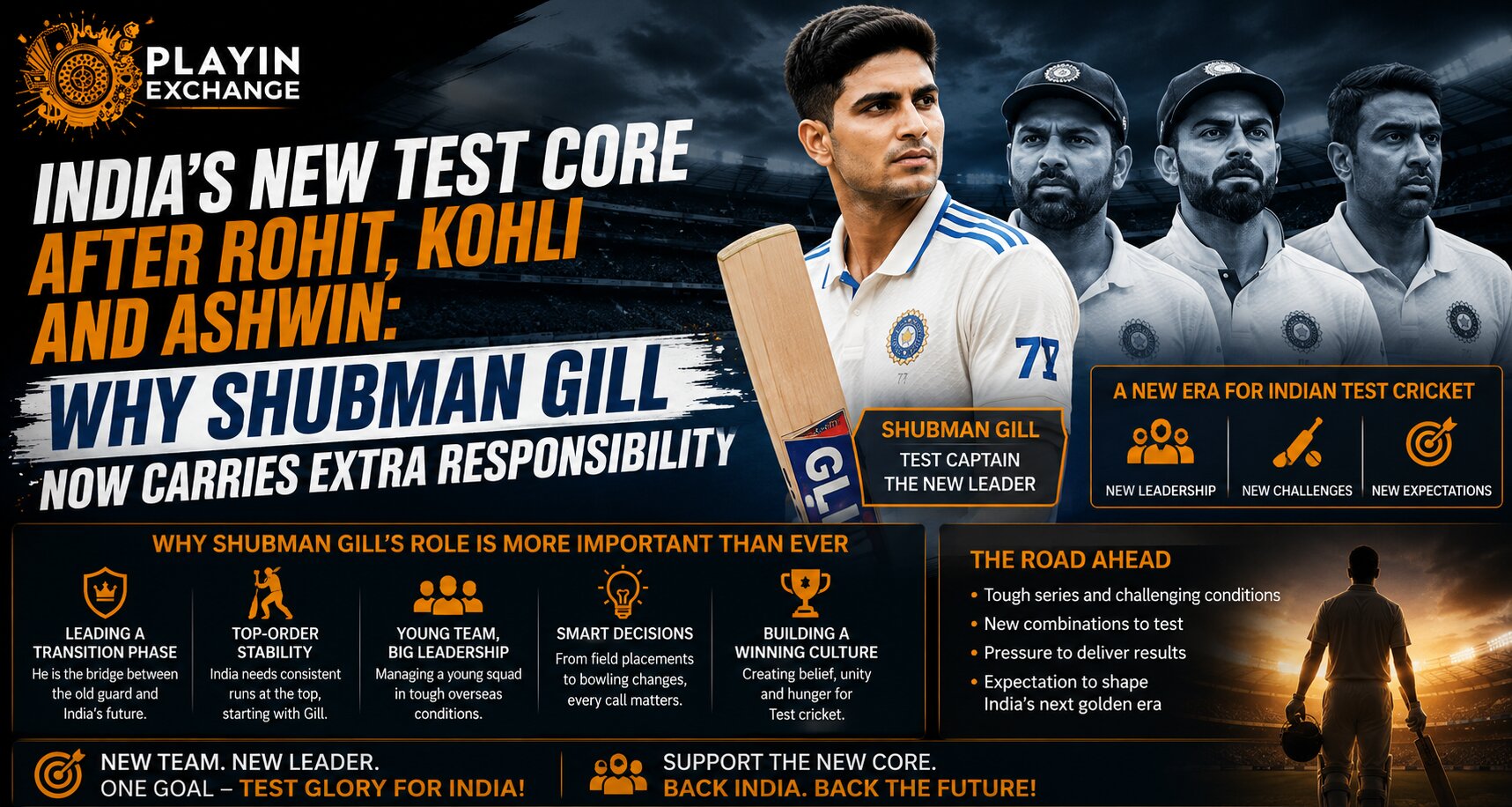
Indian Test cricket has entered one of its biggest transition periods in years. Ravichandran Ashwin retired from international cricket in December 2024, Rohit Sharma ended his Test career in May 2025, and Virat Kohli followed only days later. For fans following the changing team through Playinexch, Shubman Gill has consequently become much more than an important top-order batter. He is now India’s Test captain and one of the central figures responsible for shaping the identity, standards and results of the next generation.
India Lost Three Major Test Figures in a Short Period
Few teams can replace so much experience immediately.
Ashwin finished with 537 Test wickets, the second-highest total by an Indian bowler. Kohli retired after 123 Tests, 9,230 runs and 30 centuries, while Rohit ended his red-ball career after 67 Tests.
The ICC noted when Gill took over that Rohit, Kohli and Ashwin represented a combined 296 Tests of experience. Their departures affected far more than the scorecard.
India simultaneously lost:
- A successful Test captain in Rohit
- An experienced No. 4 and former captain in Kohli
- One of their greatest home-match bowlers in Ashwin
- Decades of knowledge about difficult overseas conditions
- Three influential voices from the dressing room
For followers using Playinexch Login, this explains why India’s transition is about leadership as much as replacing individual performances.
Why Shubman Gill Became the Centre of the Rebuild
Gill was appointed India’s full-time Test captain ahead of the 2025 England tour after Rohit’s retirement. At 25, he became India’s youngest full-time Test skipper since Sachin Tendulkar took charge at 23 in 1996.
That long-term appointment effectively placed Gill at the centre of the new era.
The responsibility is particularly demanding because he must develop his own Test batting while simultaneously managing:
- Team selection and combinations
- Young players entering the Test side
- Bowling changes and field settings
- Expectations after an experienced generation
- India’s World Test Championship ambitions
For Play Exchange followers, Gill’s challenge is therefore different from simply replacing Rohit as captain. He has to help establish an entirely new core.
Gill Also Has a Bigger Batting Responsibility
Kohli’s retirement created a major vacancy in India’s middle order.
For roughly three decades, India’s No. 4 position was largely defined by Sachin Tendulkar and then Kohli. The ICC identified Gill as one possible long-term solution for that crucial position when discussing the challenges facing India’s new captain.
That means Gill cannot afford to think only like a captain.
India need him to become one of the batting group’s dependable anchors, particularly when younger players are still establishing themselves.
A Playinexch ID follower should therefore judge Gill’s next phase on two connected areas: his tactical development as captain and his ability to produce important runs under pressure.
Who Forms India’s New Test Core Around Gill?
India are not rebuilding around Gill alone.
The updated squad for the August 2026 Sri Lanka Tests includes KL Rahul as vice-captain, Yashasvi Jaiswal, Rishabh Pant, Dhruv Jurel, Ravindra Jadeja, Kuldeep Yadav and several developing fast bowlers.
The emerging leadership and performance group could include:
- KL Rahul for experience and tactical support
- Yashasvi Jaiswal as a long-term top-order batter
- Rishabh Pant as an established match-changing wicketkeeper-batter
- Ravindra Jadeja as the senior all-rounder
- Kuldeep Yadav as an increasingly important specialist spinner
- Mohammed Siraj as an experienced pace-bowling figure
For Playinexch Online ID readers, the important point is that leadership may become more distributed than it was during the Rohit-Kohli-Ashwin era.
Replacing Ashwin May Be the Hardest Tactical Challenge
India can replace a batting position more directly. Replacing Ashwin’s influence is much more complicated.
His partnership with Jadeja produced 587 Test wickets when the pair played together, helping form the foundation of India’s long period of home dominance.
Kuldeep Yadav and other spin options now have greater responsibility, but India may have to rethink how they structure their attacks rather than search for an identical replacement.
This also increases Gill’s tactical workload. Managing spinners on turning tracks, setting attacking fields and deciding when to change combinations will become important parts of his captaincy.
Sri Lanka Is Another Important Test of the New Era
India’s updated squad for the Sri Lanka series again confirms Gill as captain, with Rahul serving as vice-captain. The first Test begins in Galle on August 15, 2026.
For Play Exchange followers, this tour is particularly interesting because the conditions can test both batting against spin and Gill’s ability to manage his own slow bowlers.
Success would provide another sign that India are developing an identity independent of the previous generation.
Why Gill Cannot Carry Everything Alone
Making Gill the centre of the transition does not mean every result should depend on him.
A successful new Test core needs responsibility shared among senior and developing players. Rahul can contribute leadership experience, Pant can influence matches aggressively, Jaiswal can strengthen the batting foundation, while Jadeja and Kuldeep can guide the spin attack.
For users following India through a Playinexch ID, the healthiest transition would be one where Gill leads without becoming responsible for solving every weakness himself.
Conclusion
The retirements of Rohit Sharma, Virat Kohli and Ravichandran Ashwin closed an extraordinary chapter of Indian Test cricket within a remarkably short period.
Shubman Gill now sits at the centre of what comes next.
For Playinexch Online ID followers, his challenge is not simply to captain India. He must score important runs, develop younger players, rebuild the leadership group and help India find new ways to win without three players who shaped an entire generation.
The new Test core is already taking form. How successfully Gill leads it could define the next several years of Indian red-ball cricket.
FAQs
When did Rohit Sharma retire from Test cricket?
Rohit Sharma announced his Test retirement on May 7, 2025, ending a 67-Test career.
When did Virat Kohli retire from Tests?
Kohli announced his Test retirement on May 12, 2025. He finished with 9,230 runs and 30 centuries from 123 Tests.
When did Ravichandran Ashwin retire?
Ashwin retired from international cricket on December 18, 2024, during India’s tour of Australia.
Who is India’s current Test captain?
Shubman Gill is India’s Test captain. The BCCI’s latest Sri Lanka squad also lists KL Rahul as vice-captain.
Who could form India’s new Test core?
Gill, Jaiswal, Pant, Rahul and Kuldeep are among the important figures moving forward, while experienced players such as Jadeja and Siraj continue to provide stability around the younger group.