
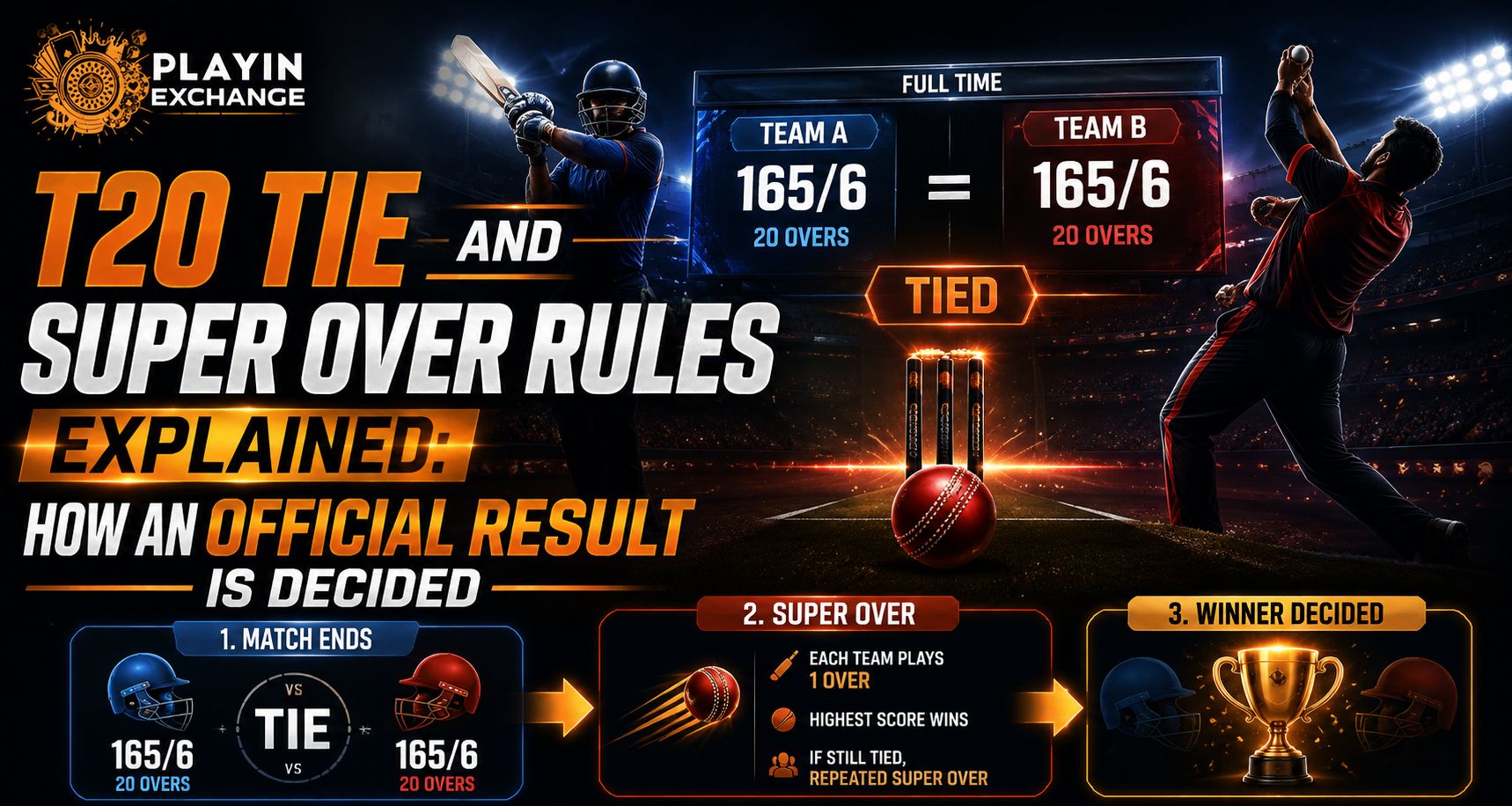
T20 cricket can occasionally produce the rare situation where both teams finish with exactly the same score. For cricket followers using Playinexch, that does not necessarily mean the match simply ends as a tie. Under the current ICC Men’s T20I Playing Conditions, a tied match proceeds to a Super Over, where both teams receive a short additional innings to determine the winner. If that Super Over is also tied, further Super Overs are normally played until one team finishes ahead.
When Is a T20 Match Officially Tied?
A standard T20 is tied when the teams finish their completed innings with equal scores. The same principle can apply to an interrupted match decided using the Duckworth-Lewis-Stern method if the chasing team finishes exactly level with the calculated par score.
For someone checking results after Playinexch Login, it is useful to separate a tied regulation match from the final official result.
The normal sequence is:
- Both teams complete their innings.
- Their scores finish level.
- The match is classified as tied at that stage.
- A Super Over is then used to determine the winner.
- If necessary, additional Super Overs follow.
What Exactly Is a Super Over?
A Super Over gives each team one additional over of up to six legal deliveries.
The team scoring more runs during those two one-over innings wins the match. The number of wickets lost does not act as a separate tiebreaker. However, if the batting side loses two wickets before completing six balls, its Super Over innings ends immediately.
For Play Exchange followers, the basic structure is therefore much simpler than another full T20 innings:
- Maximum six legal balls per team
- Maximum two wickets
- One bowler delivers the over
- Higher Super Over total wins
Which Team Bats First in the Super Over?
The order is reversed from the original match.
Under ICC procedure, the team that batted second during the main match bats first in the initial Super Over.
For example, if India chased during the original T20 and finished level with Australia, India would bat first in the Super Over.
A Playinexch ID user following a close finish should therefore not assume that the team batting first during regulation cricket will also begin the tiebreaker.
What Happens If the Super Over Is Also Tied?
This is where modern Super Over rules differ significantly from older tiebreak systems.
If both teams score the same number of runs in the first Super Over, another Super Over is played. This process normally continues until there is a winner. The 2026 ICC Men’s T20 World Cup also explicitly used this repeated-Super-Over system for tied matches.
During a subsequent Super Over:
- The team that batted second in the previous Super Over bats first.
- A batter dismissed in an earlier Super Over cannot bat again in a later one.
- The bowler used in the previous Super Over cannot bowl the immediately following Super Over.
- The fielding team bowls from the opposite end to the one it used previously.
For Playinexch Online ID readers, these restrictions mean captains may need several different batters and bowlers if a match requires multiple Super Overs.
Can a Team Lose Two Wickets Before Six Balls?
Yes.
A Super Over innings ends when two wickets are lost, even if fewer than six legal deliveries have been bowled.
Suppose a team scores seven runs but loses its second wicket after four balls. Its innings finishes at that moment. The opposition then needs eight runs to win from its available deliveries.
That makes wickets particularly valuable in a Super Over because only two dismissals are required to end the innings.
What Fielding Rules Apply?
ICC rules specify that the same fielding restrictions applicable to the final over of an uninterrupted T20 innings also apply during the Super Over.
Each team is also allowed one unsuccessful player review per Super Over innings, regardless of how many unsuccessful reviews it used during the original match.
For Play Exchange followers, those details matter because the Super Over is effectively a separate miniature contest while still operating within the wider match regulations.
What If Weather Stops the Super Over?
Weather or other unavoidable interruptions can occasionally prevent the tiebreaker from being completed.
ICC rules provide additional time for Super Overs, but if the required Super Over or subsequent Super Overs cannot be completed, the match is ultimately declared tied. Exceptional time constraints can also allow the match referee to limit the number of possible Super Overs after informing both captains.
A Playinexch ID user should therefore wait for the official result rather than assuming that a regulation tie automatically guarantees a Super Over winner.
Do Betting Markets Always Count the Super Over?
Cricket’s official result and the settlement conditions of an individual market are separate questions.
Playinexch states that cricket markets can have changing availability and platform-specific rules, and users are advised to review market details before participating.
For Playinexch Login users, this means checking whether a particular market includes a Super Over rather than assuming every market is settled identically.
Conclusion
Modern T20 rules are designed to produce a winner whenever conditions allow. When regulation scores finish level, each team normally receives a six-ball Super Over, with two wickets ending an innings. If the first Super Over is tied, additional Super Overs continue until one team outscores the other.
For Playinexch Online ID followers, the key distinction is simple: a tied score at the end of 20 overs may only be the beginning of the final result process. The official outcome should always be confirmed after any required Super Over has been completed.
FAQs
How many balls are played in a Super Over?
Each team can face up to six legal deliveries. The innings can finish earlier if two wickets are lost.
What happens when a T20 match finishes with equal scores?
Under current ICC Men’s T20I rules, a Super Over is played to determine the winner, provided conditions allow it.
What happens if the Super Over is tied?
Another Super Over is normally played, and further Super Overs continue until a winner is determined.
Who bats first in the Super Over?
The team that batted second during the original match bats first in the initial Super Over.
Can the same bowler bowl consecutive Super Overs?
No. A bowler who delivered the previous Super Over is ineligible to bowl the immediately following Super Over.