
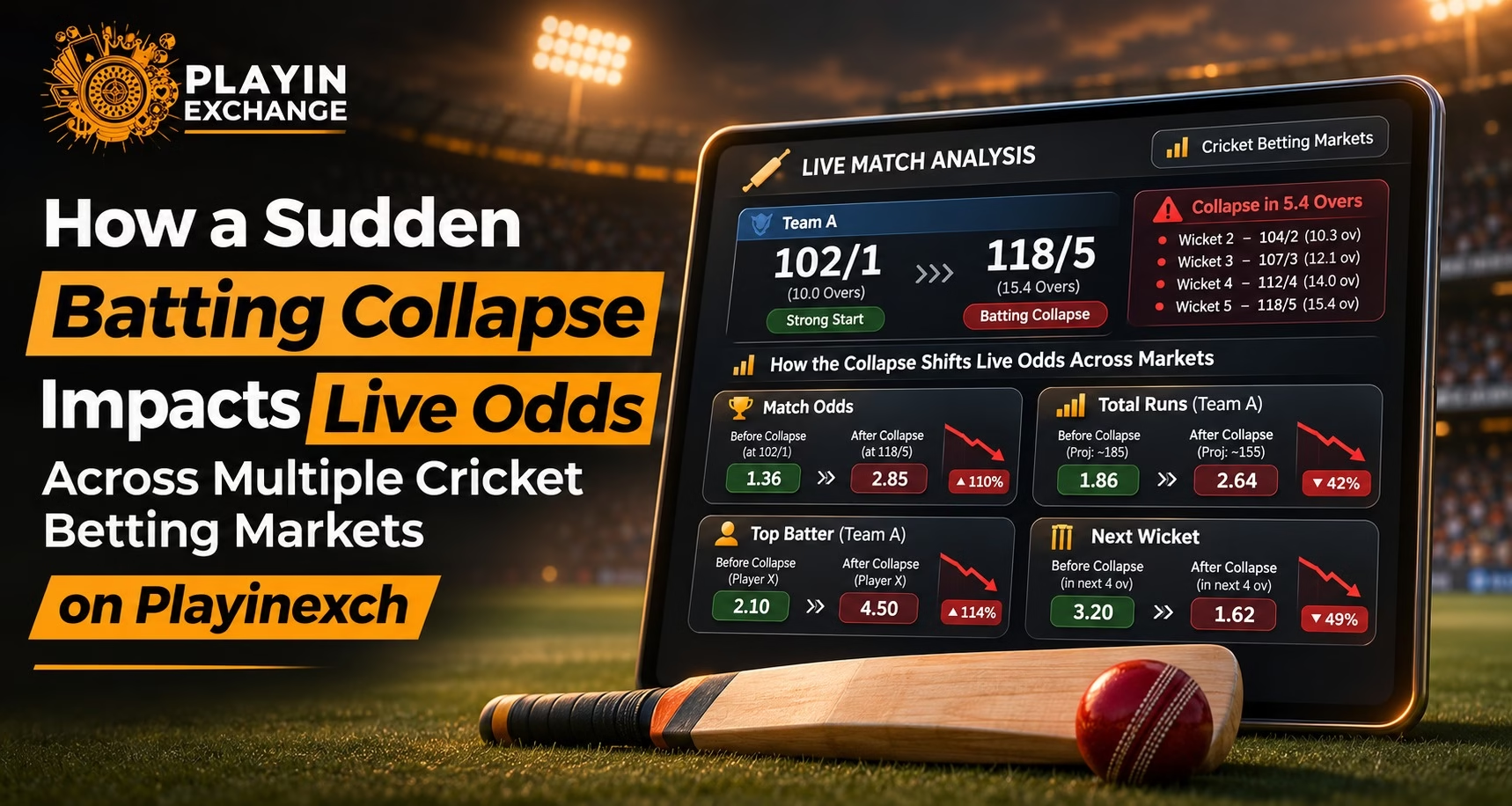
A cricket match can change dramatically when several wickets fall within a few deliveries. For fans following live cricket on Playinexch, a sudden batting collapse can influence match odds, innings totals, session markets, and player-specific prices. Understanding these changes helps users interpret live market movements rather than reacting to individual wickets without considering the match situation.
What Is a Sudden Batting Collapse in Cricket?
A batting collapse occurs when a team loses multiple wickets within a short period, often without adding many runs.
For example, imagine a T20 team moving from 98/1 after 11 overs to 104/4 after 13 overs. Three wickets have fallen while only six runs were scored.
Such a collapse can affect:
- Expected innings totals and scoring rates.
- Remaining batting strength.
- Match-winning probabilities.
- Upcoming over and session expectations.
- Demand and available prices across live markets.
However, the impact depends on match conditions and the remaining players.
How Does a Batting Collapse Affect Different Live Markets?
Different cricket markets respond to wickets according to their underlying outcomes.
| Cricket market | Possible impact | Main reason |
| Match winner | Batting team’s odds may increase | Lower perceived winning probability |
| Innings total | Expected total may decrease | Fewer established batters |
| Session runs | Short-term scoring expectations may fall | New batters face pressure |
| Player runs | Dismissed player’s market may settle | Individual innings has ended |
| Next-wicket market | Prices may be revised | Changing batting order and wicket risk |
These are common market categories; individual availability depends on the platform and event.
Example: How Three Quick Wickets Change T20 Live Odds
Consider Team A chasing 175 runs.
Before the collapse:
- Score: 98/1 after 11 overs.
- Runs required: 77 from 54 balls.
- Required run rate: 8.56.
- Illustrative decimal odds: 1.65.
After losing three wickets:
- Score: 104/4 after 13 overs.
- Runs required: 71 from 42 balls.
- Required run rate: 10.14.
- Illustrative decimal odds: 2.50.
The implied probability changes from approximately 60.6% to 40%, calculated as 1 divided by decimal odds.
These hypothetical Play Exchange prices illustrate how expectations might change. They are not actual quotations or reliable predictions.
Why Do Multiple Markets React Differently?
A collapse does not affect every market equally.
1. Match Odds Respond to Winning Probability
Losing important batters can reduce a team’s perceived chances of winning. However, an experienced lower order or favourable conditions can limit the effect.
2. Innings Totals Reflect Remaining Batting Resources
An innings-total market considers wickets, scoring rate, available overs, and batting depth.
3. Session Markets Respond to Immediate Pressure
When new batters arrive, short-term scoring expectations may fall. A strong partnership can reverse that movement.
On Play Exchange, available prices also depend on market liquidity and participant activity.
How to Analyse Live Odds After a Batting Collapse
Users can follow these steps to understand sudden movements.
- Check the scoreboard: Record runs, wickets, and completed overs.
- Identify dismissed players: Losing an established batter may matter more than losing a tailender.
- Calculate the required run rate: During a chase, divide remaining runs by remaining legal balls and multiply by six.
- Compare markets: Examine match odds, innings totals, and available session prices independently.
- Check market status: Verify whether orders are matched, unmatched, or temporarily suspended.
- Review playing conditions: Consider pitch behaviour, bowling strength, weather, and remaining batters.
After Playinexch Login, users should read the applicable market rules before interpreting displayed prices.
Why Can Live Odds Freeze After Consecutive Wickets?
Cricket exchanges may temporarily suspend markets when significant match events occur.
Common reasons include:
- Consecutive wickets or run-outs.
- Pending umpire reviews.
- Scoreboard corrections.
- Rapid changes in available prices.
A previously displayed price may disappear before an order is matched.
Anyone reviewing information through the Playinexch Apk should independently verify live scores and understand possible transmission delays.
Common Mistakes When Reading Sudden Odds Changes
A Playinexch ID provides access to account features, but accurate match interpretation still requires careful analysis.
Avoid these mistakes:
- Assuming three wickets guarantee defeat.
- Confusing decimal odds with certain outcomes.
- Ignoring match conditions and remaining batting strength.
- Reacting to outdated prices.
- Increasing financial exposure after sudden movements.
Use Playinexch Login through a verified website. If using a Playinexch Apk, confirm its source and protect your credentials.
Conclusion
A sudden batting collapse can influence several live cricket markets simultaneously, but the scale and direction of movement depend on the match situation.
Playinexch users can better understand these changes by examining wickets, scoring pressure, market liquidity, and remaining batting resources. Any real-money activity should follow applicable laws, age restrictions, and responsible financial limits.
Frequently Asked Questions
1. Why do live odds change after consecutive wickets?
Wickets change the match situation and participants’ expectations, causing available prices to adjust.
2. Does a batting collapse always reduce the expected innings total?
No. Remaining overs, batting depth, and playing conditions also influence expectations.
3. Why do cricket markets temporarily freeze after wickets?
Markets may suspend while significant events are confirmed and prices are updated.
4. Can one batting collapse affect multiple markets?
Yes. Match winner, innings total, player runs, and session markets may respond differently.
5. Can a team recover after losing several quick wickets?
Yes. Strong partnerships, experienced finishers, and favourable conditions can help a team recover.