Digital payments have made transactions faster and more convenient, but occasional issues such as pending payments, failed transfers, or incorrect deductions can create confusion. Understanding where to raise a complaint is important for resolving payment-related problems efficiently. Users tracking account activity through Playinexch can benefit from knowing whether they should contact their bank, UPI application provider, or the RBI Ombudsman for different payment concerns.
Every payment issue has a suitable resolution channel. While some problems can be solved quickly through a bank or UPI support team, others may require escalation through formal complaint mechanisms. Choosing the right authority can save time and help users receive proper assistance.
Understanding Different Types of Payment Problems
Before contacting any support channel, users should identify the type of payment issue they are facing.
Common payment problems include:
- Transaction showing as pending
- Money deducted but payment failed
- Incorrect amount transferred
- Refund not received
- Unauthorised transaction
- Account balance mismatch
Each situation may require a different approach depending on where the issue occurred and which service provider handled the transaction.
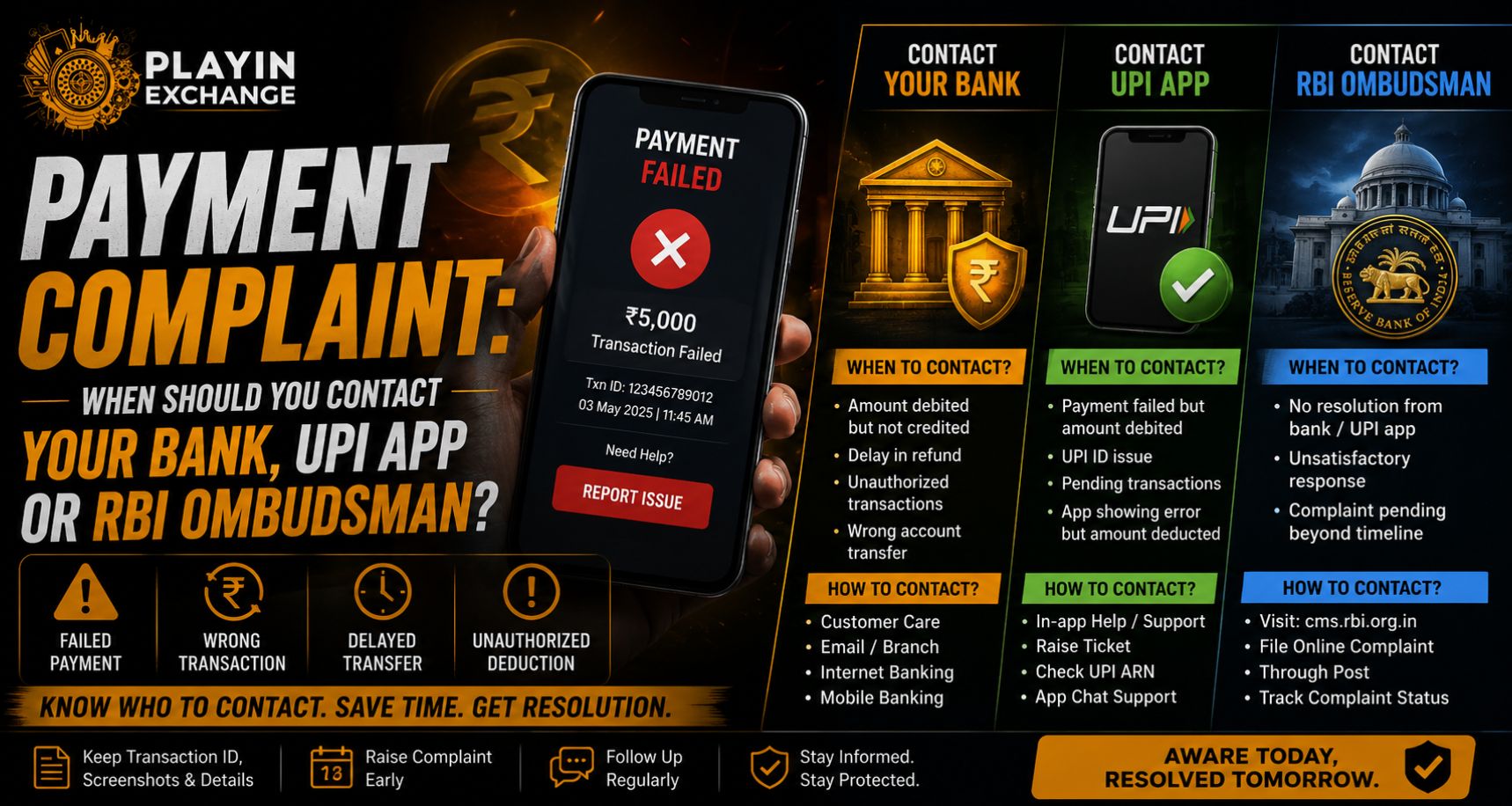
When Should You Contact Your Bank?
Your bank should usually be the first point of contact for issues directly related to your bank account or payment processing.
You should contact your bank when:
- Money has been deducted from your account incorrectly
- A transaction is not reflected properly
- An unauthorised payment appears
- Refunds are delayed
- Account-related restrictions affect payments
Banks can investigate transaction records, check payment status, and provide updates about account-level issues.
Keeping transaction details ready can make the complaint process easier.
Important information includes:
- Transaction reference number
- Date and time of payment
- Amount involved
- Payment method used
- Receiver details
When Should You Contact Your UPI App?
UPI applications are responsible for managing the digital payment interface and transaction experience. If the issue is connected to the application itself, contacting the UPI provider may be helpful.
You should approach your UPI app support when:
- The app shows incorrect transaction status
- Payment history is not updating
- Technical errors prevent transactions
- UPI services are unavailable
- The application is not working properly
UPI providers can check technical issues and guide users through troubleshooting steps.
Difference Between Bank Support and UPI Support
Many users are unsure whether to contact their bank or UPI application. The correct choice depends on where the problem occurred.
Bank support is more suitable for:
- Account balance issues
- Debit-related problems
- Banking restrictions
- Account security concerns
UPI app support is better for:
- Application errors
- Interface problems
- Failed UPI requests
- Technical payment issues
In some cases, both the bank and UPI provider may need to coordinate to resolve the issue.
When Should You Approach the RBI Ombudsman?
The RBI Ombudsman is an escalation option when a complaint is not resolved through the relevant financial institution.
Users should consider approaching the RBI Ombudsman when:
- The bank does not provide a satisfactory response
- The complaint remains unresolved after the required process
- The financial service provider fails to address the issue properly
The Ombudsman system helps customers raise concerns related to regulated financial services after attempting resolution through the service provider.
Steps to Follow Before Escalating a Payment Complaint
Before approaching higher authorities, users should complete the standard complaint process.
Recommended steps include:
- Contact the concerned bank or payment provider
- Keep complaint reference numbers
- Save transaction screenshots and records
- Wait for the official response period
- Escalate only if the issue remains unresolved
Maintaining proper records makes the complaint process smoother.
Users managing their accounts through Playinexch Login can also review available transaction details and payment records before raising concerns.
Importance of Keeping Payment Records
Proper documentation is essential when dealing with payment disputes.
Users should keep:
- Payment confirmations
- Transaction IDs
- Bank statements
- Support communication records
- Screenshots of errors
Clear records help Support Teams understand the problem and provide faster solutions.
How Digital Platforms Improve Payment Tracking
Modern digital platforms provide better visibility into account activity and transaction history. Users can review payment details, monitor updates, and identify issues more easily.
Through services connected with Play Exchange, users can better understand transaction information and maintain awareness of account activities.
Common Mistakes to Avoid During Payment Complaints
Many complaints take longer to resolve because users do not provide complete information.
Common mistakes include:
- Sharing incomplete transaction details
- Contacting the wrong support channel
- Not keeping complaint numbers
- Repeating requests without checking updates
- Ignoring official responses
A structured approach usually leads to faster resolution.
Final Thoughts
Knowing when to contact your bank, UPI app, or RBI Ombudsman can make payment complaint resolution easier. Most issues should first be handled through the concerned bank or payment provider, while the RBI Ombudsman should be considered only after proper escalation.
Understanding the correct process helps users manage payment concerns more effectively. Whether checking transaction history through a Playinexch ID or reviewing payment information elsewhere, keeping records and following the right steps remains important.
FAQs
Should I contact my bank first for a failed payment?
Yes, the bank is usually the first point of contact for account-related payment issues and transaction failures.
When should I contact my UPI app support?
You should contact the UPI app when the problem involves technical errors, app issues, or incorrect transaction displays.
What does the RBI Ombudsman do?
The RBI Ombudsman helps customers escalate unresolved complaints against regulated financial service providers.
What details are needed for a payment complaint?
Users should keep transaction IDs, payment dates, amounts, and screenshots related to the issue.
Can payment complaints be resolved without escalation?
Yes, many payment issues are resolved by banks or payment providers when proper details are provided.